The Mediator
"Bridging conflicting systems, making languages intelligible."
The Mediator is more than just a starting point for me; it is the cornerstone that unites every layer of my identity—from a decade in Turkish (and although for a very short while, also British) diplomacy to international tech management. This is the perennial master synthesizer, the "generalist" who often outperforms specialists in any field they enter. However, there is a far more critical reason why I've placed this archetype at the top of the SIS hierarchy.
The professional world still operates on deeply gendered dynamics. Many women are nudged, often unconsciously and from a very young age, to adopt this archetype as their primary identity. They become the bridge-builders, the tension-managers, and the harmonizers—balancing the emotional labor of house care and child-rearing with the demands of business.
I was one of them.
Despite a fast-moving mind and high intuitive clarity, I allowed emotional empathy and "other-centeredness" to hijack my system, fueled by cultural coding. I mistook my emotions for my primary navigation tool simply to meet external expectations. It took a decade of diplomacy ending in severe burnout at age 31, followed by six years of rebuilding, to realize I was trapped in a self-exhausting feedback loop. My actual contribution was clarity and structured, future-oriented thought—yet I was drowning in emotional labor.
I urge readers, especially women, to maintain a healthy skepticism here. Ask yourself: Is this truly your core, or is it a survival mechanism designed to satisfy the world around you?
So who is the Mediator, stripped of the survival mechanisms?
The Mental Adhesive of Society
Mediators are the mental "adhesives" of a globalized world. From childhood, they stand out with grace, poise, and a natural mastery of both written and oral expression. Yet, unlike a politician or an academic, the essence of a Mediator is not found in ideological fervor. They seek to understand thoughts and synthesize observations. Their reluctance to limit their minds with utilitarian categories positions them at the intersection of disciplines—making them, in essence, the ultimate "public intellectuals."
Agent Interjection
The diplomatic corps loves a clean conscience. Until someone reads the footnotes.
Harold Nicolson: The High-Range Synthesizer
To illustrate the life trajectory of a pure Mediator, we look to Harold Nicolson—a man of manifold talents described by Faber as a novelist, diplomat, journalist, biographer, and gardener. Born in Tehran (1886) to a top-tier diplomat, Nicolson was native to the inner sanctum of the Foreign Office. His childhood was a whirl through Tehran, Constantinople, Madrid, Sofia, and St. Petersburg. This early exposure to "otherness" forced him to develop the core Mediator trait: the ability to translate not just words, but intent and culture across borders.
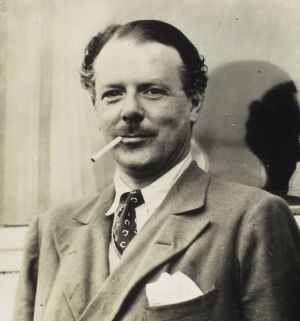
Following the conventional path of his class, public school and Balliol, he entered the diplomatic service in 1909. After Madrid, his first major posting was Istanbul (1912–1914), where he operated at the literal threshold between East and West. His accounts from this period remain some of the clearest illustrations of the challenges of "Cambridgian logic" meeting the intuitive reasoning of the Levant.
Yet, even a master synthesizer is not immune to the biases of his upbringing—in Peacemaking, Nicolson's diplomatic mask occasionally slips into the racial stereotyping of his era, a reminder that the ability to bridge cultures does not automatically grant immunity from the prejudices embedded within them.
The Messenger of Doom (1914)
On the night of August 4, 1914, Nicolson was the junior official tasked with the most somber errand in modern British history. He walked from the Foreign Office to the German Embassy to deliver the formal declaration of war. During the war, he was one of the chief draftsmen of the Balfour Declaration, which committed Britain to supporting a Jewish homeland in Palestine.
By the time the Paris Peace Conference convened in 1919, Nicolson was a key junior member of the British delegation. He was young, brilliant, and, crucially, he believed in the "New World" logic of Woodrow Wilson and the League of Nations.
His work was so tireless and technically precise that in 1920, he was appointed a Companion of the Order of St Michael and St George (CMG). To the outside world, he was a rising star with a flawless trajectory. To Nicolson, however, the "honor" felt like a badge of failure.
"We are all so tired that we can no longer distinguish between what is important and what is merely urgent. We are touchy, vanity-stricken, and exhausted. We have lost our sense of perspective... we are just small men playing with the map of the world." — Harold Nicolson, on the Paris Peace Conference
"I have also indicated the acute difficulty experienced by the negotiators in Paris in reconciling the excited expectations of their own democracies with the calmer considerations of durable peacemaking. Such contrast can be grouped together under what will forever be the main problem of democratic diplomacy; the problem, that is, of adjusting the emotions of the masses to the thoughts of the rulers."
The most poignant moment of this era is his interaction with Arthur Balfour, the veteran statesman. Nicolson, exhausted by the "other-centered" labor of trying to reconcile impossible borders and broken promises, reached a breaking point.
He famously confessed his disillusionment and exhaustion to Balfour, whose response was a chilling lesson in the nature of power:
"My dear Harold, you take these things too much to heart... We are merely trying to make the world a little less chaotic." — Arthur Balfour
For a Mediator who relies on clarity and the belief that every conflict has an "ideal" solution, this was a crushing blow. He realized that the "feedback loop" of diplomacy led to a repetitive cycle of managing catastrophes. But to this day his account on the nature of diplomacy remains one of the best:
"It is essential that a negotiator should be able to divest himself of his own opinion in order to place himself in the position of the Prince with whom he is negotiating. He should be able, that is, to adopt the other's personality, and to enter into his views and inclinations. And he should thus say to himself — 'If I were in the place of that Prince, endowed with equal power, governed by identical prejudices and passions, what effect would my own representations make upon myself?'" — Harold Nicolson, Diplomacy
Written by Pinar Atik
Continue: The Mediator — Part II
The Great Pivot: what happens when a Mediator leaves the wrong arena.
Read Part II →Which archetype are you operating from?
Discover Your Archetype →SIS Intelligence Drops
Archetype insights and structural career intelligence. No fluff.