The Wanderer
"Building structure while moving through the unknown."
Strategic Identity Synthesis emerged from six months of building a human-centric, dynamic self-exploration system. One of its core goals: filter out the external noise amplified by algorithmic manipulation and hone in on our essential humanity—our identity. This process led me to explore the lives of many inspiring figures from recent history, and it brought me back to one idea, again and again: human resilience.
The Embodiment
Thor Heyerdahl, the Norwegian explorer, archaeologist, and adventurer, perfectly embodies the motto of SIS's Wanderer Archetype: building structure while moving through the unknown. He quite literally built his own rafts to prove that people had crossed oceans long before Columbus and the invention of heavy-duty ships.
Born in Larvik, Norway in 1914, Heyerdahl devoured adventure books from childhood and studied zoology at Oslo University, encouraged by his mother's Darwin-inspired sensibility. He assembled a private library on Polynesia using the world's largest collection of Pacific literature at the time. Yet he never graduated. By 1936, at twenty-two, he had already prioritized field adventures over formal academia, a pattern that would define his entire career.
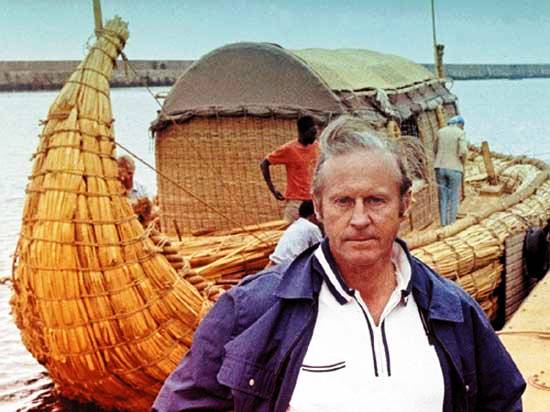
True to his Wanderer spirit, his first major journey was an escape from civilization. In 1937, newly married to Liv Coucheron Torp and financed by his father's modest brewery fortune, Heyerdahl arrived on Fatu Hiva, a remote island in the Marquesas, to live primitively: a bamboo hut, fish and breadfruit, no modern tools. The plan was to merge with nature and never return home.
Nature had other ideas. Liv contracted a tropical infection. Heyerdahl battled malaria-like symptoms. Fatu Hiva was not the blank slate they had imagined — the island carried its own history of conflict, shaped by generations of inter-tribal tension and colonial disruption. Forced relocations, witnessed violence, the slow erosion of the idyll they had built in their minds: what had been designed as an escape began to feel more like endurance. What began as an escape turned into something else entirely, because Thor Heyerdahl was, at his core, a scientist.
The Seed of a Disruptive Idea
Through oral traditions and local myths, along with subtle cultural and botanical clues, he began to suspect there was a connection between the islanders' origins and Peru. After all, the sweet potato, native to Peru, was present across Polynesia. It planted a disruptive idea in his mind, one that would take nearly a decade to fully form:
What if the first settlers of Polynesia had come not only from Asia, but also from the Americas?
Agent Interjection
The academic establishment loves a clean model. Until someone actually tests it.
When he returned to Europe, the idea stayed with him. What he had sensed intuitively on the island, he now tried to trace through research—studying migration patterns, ancient cultures, and the movement of plants and people across oceans.
But the more he pursued it, the more resistance he encountered. The academic world dismissed the possibility outright. The prevailing model was clear, established, and not open to reinterpretation.
For nearly a decade, the idea remained suspended between intuition and proof. Back in Norway by 1938, Heyerdahl and Liv had two sons. World War II consumed the continent. He worked odd jobs while Norway lived under occupation, struggling for funding and academic recognition of his diffusion theories. The academy had no interest in rewriting its models for an explorer without a degree.
Until Heyerdahl made a decision that would define his path: If the theory could not be proven on paper, it would have to be tested in the real world.
101 Days at Sea
The test he had in mind was audacious to the point of being absurd: build a raft using only materials and techniques available to pre-Columbian peoples, and sail it from the coast of Peru to Polynesia. No modern navigation. No engine. If the crossing had been possible a thousand years ago, it should be possible now. He would make the journey himself.
He self-financed the expedition through lectures and writings, recruiting five crew members with no sailing experience, and relying on the Humboldt Current and trade winds to carry them. In Peru, they built an authentic balsa wood raft using pre-Columbian techniques and named it Kon-Tiki, after the Inca legend of Viracocha: the pale god who, according to Spanish chroniclers, had sailed west across the Pacific from Lake Titicaca after being driven out by his own people. The mythology mirrored the hypothesis. Ancient voyagers had crossed this ocean before.
In 1947, ten years after he first set foot in the Marquesas Islands, Thor Heyerdahl left the coast of Peru on the Kon-Tiki. With no modern navigation tools, the raft carried him and his small crew into the Pacific with little control over where they would end up.
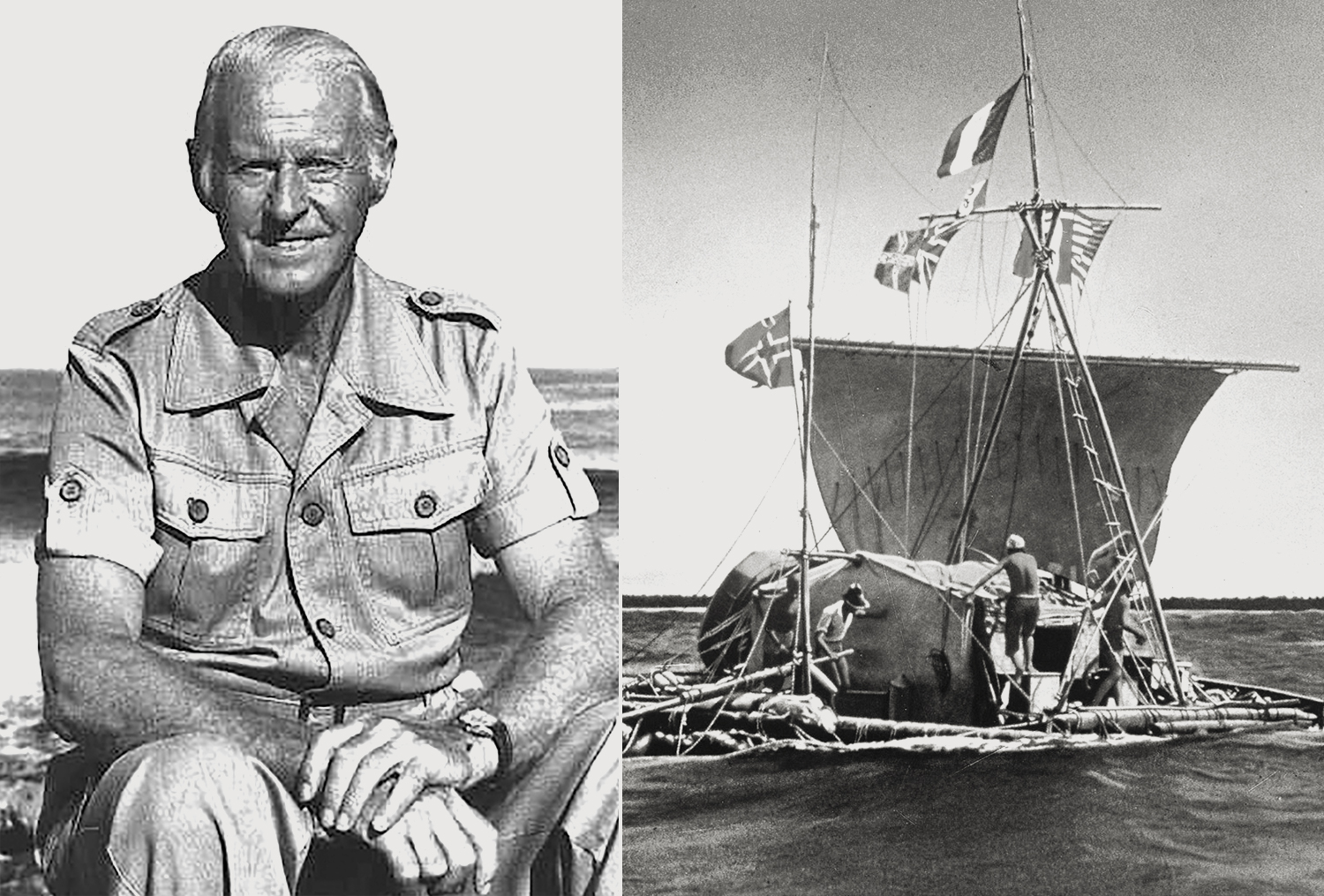
For 101 days, they drifted across the ocean.
There was no engine, no reliable way to steer—only currents, winds, and a rough sense of direction. Sharks followed the raft for days. Storms hit without warning. Supplies were limited, and the vastness of the ocean reduced everything to a single, repetitive horizon.
What he had imagined as a theory was now a physical condition.
Day after day, the question that had once lived in books and notes was no longer abstract. It was in the salt on their skin, in the uncertainty of each night, in the slow realization that survival itself depended on the same forces early voyagers would have faced.
After 101 days at sea, when the raft finally struck the reefs of the Tuamotu Islands, the journey proved that such a crossing was entirely possible.
And that was enough to reopen the question.
What Heyerdahl had done was challenge the certainty of an existing answer.
The personal cost was real. Liv had waited at home through the years of obsession and then through 101 days of silence over the Pacific. The distance — literal and otherwise — had done its work. They divorced in 1949. The expedition that proved everything to the world had quietly dismantled what he had built at home.
What followed was something he hadn't planned for. The account of the journey, simply titled Kon-Tiki, sold over 50 million copies across more than 70 languages, becoming one of the best-selling adventure narratives of the 20th century. The documentary filmed aboard the raft won the Academy Award for Best Documentary Feature in 1952. The man who had failed to publish a single peer-reviewed paper on his migration theory had produced a global cultural event instead. The academy remained skeptical. The world did not.
Seeker vs. Wanderer
Thor's expedition reminds us of something fundamental, although easily overlooked: There is a difference between those who search and those who wander.
What began in Fatu Hiva as a question about origins expanded, stretched across oceans, and returned in a different form. As connection, rather than certainty.
In that sense, Kon-Tiki was a continuation of a movement, one without a fixed destination or a final answer.
Beyond Inherited Conclusions
Most theories and texts about such journeys remain confined to the writings of those who followed them, turning observations into established truths. Yet the true explorer goes beyond, walking the land, seeing with their own eyes, charting their own path. It is this refusal to inherit conclusions rather than experiences that makes this Archetype exceptional.
Agent Interjection
The Wanderer doesn't reject the map. They just know the territory always wins.
Having spent time in both Sri Lanka and Peru, this part of the story stays with me for a different reason.
I don't know why life took me to these places. And I often ask myself what those unique places mean for my personal journey. But being there, moving through them, left something behind. A quiet but persistent sense that the world holds more than what we are usually taught to look for.
"Some people believe in fate, others don't. I do, and I don't. It may seem at times as if invisible fingers move us about like puppets on strings. But for sure, we are not born to be dragged along. We can grab the strings ourselves and adjust our course at every crossroad, or take off at any little trail into the unknown." — Thor Heyerdahl
Written by Pinar Atik
The Wanderer — Career Cheat Sheet
Strengths, blind spots, career moves, and a diagnostic checklist.
View Cheat Sheet →Which archetype are you operating from?
Discover Your Archetype →SIS Intelligence Drops
Archetype insights and structural career intelligence. No fluff.